
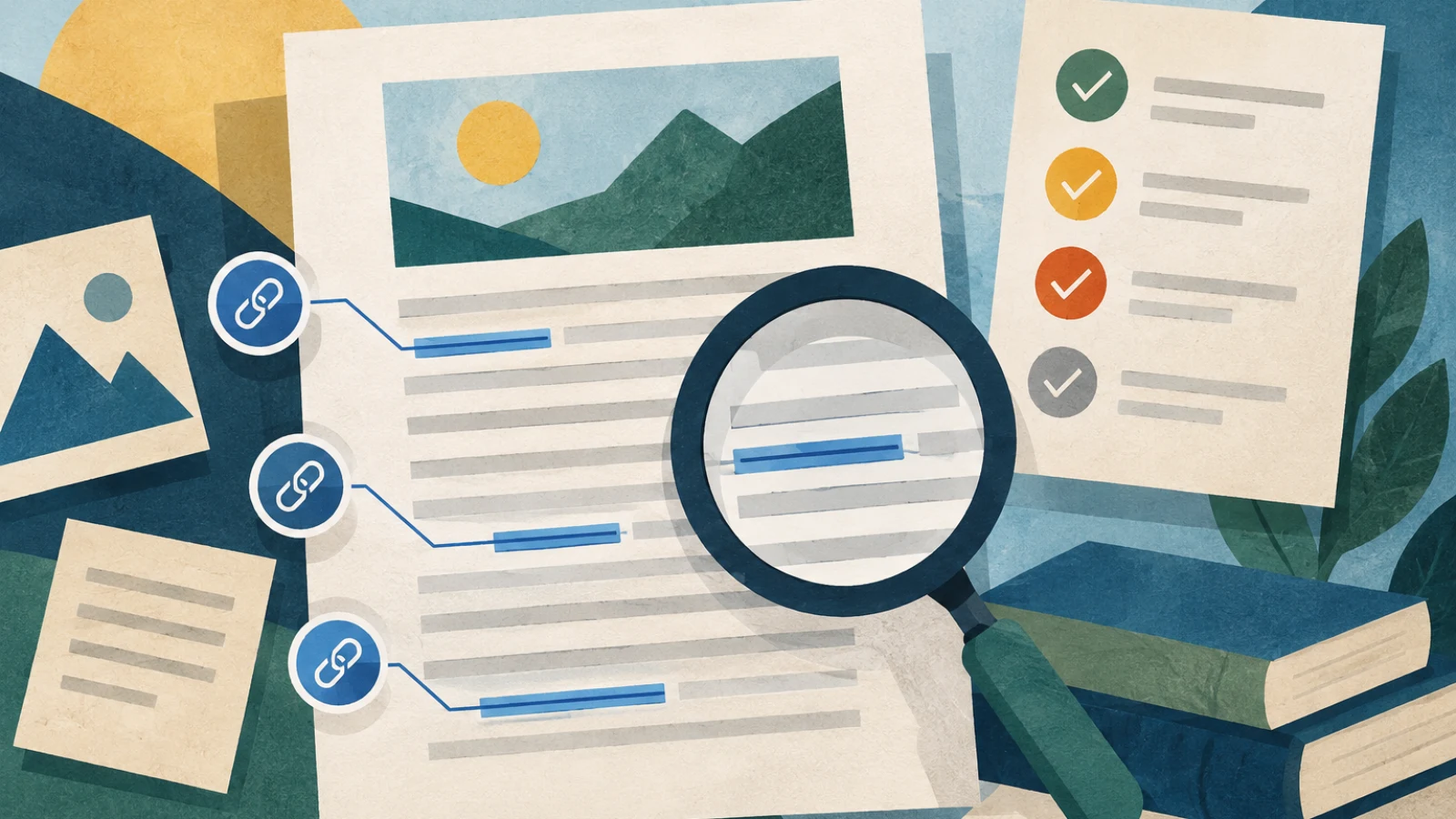
To check citations in AI-assisted articles, review each reader-facing link against the precise statement it is meant to support. This guide shows how to test claim fit, scope, currency, attribution, and usability—then make a clear replace, qualify, remove, or verify decision before publication.
AI-assisted drafting can make a complete article appear ready before its evidence has been tested. A citation may be real, accessible, and related to the topic while still failing to support the wording immediately before it. Before publishing, use a claim-by-claim review that asks a narrower question than general fact checking: does this specific source support this specific statement, at this level of certainty, for this reader? The result is a more transparent article and a review record your team can revisit when sources or business details change.
In this guide
Know what a citation is checking
A source is the underlying material: a first-party policy, dataset, study, official documentation page, interview record, or other evidence your team has decided it may use. A citation is the reader-facing reference that points to that material. A research note is an internal record of what the team found, what it means, and any limits on using it. These objects can point to one another, but they do different jobs.
Keep citation checking separate from source collection and broad accuracy review. Collection asks whether you have located potentially useful material. Fact checking asks whether a statement is accurate enough to publish. Citation checking tests the visible relationship between a claim and the evidence a reader can inspect. One source can be sound while being a poor citation for a particular sentence because it covers a different population, period, product, condition, or level of certainty. For upstream research controls, see this related guide on an AI content source workflow.
Three records to keep distinct
| Record | Primary purpose | What to capture |
|---|---|---|
| Source | Preserve the evidence your team evaluated | Publisher or owner, title, URL or location, date, scope, and access notes |
| Citation | Help a reader locate the supporting material | Clear anchor text, destination, and placement next to the supported claim |
| Research note | Document the team’s interpretation and decision | Claim tested, relevant passage or data point, limitations, reviewer, and disposition |
Test the fit between each claim and its source
Review the article in reading order, not just by opening every link in a reference list. Highlight each statement that makes a factual assertion, names a policy or feature, gives a number or date, summarizes research, describes a process, or attributes a view. Then identify the smallest claim the nearby citation must support. Breaking a long sentence into smaller assertions prevents one broad link from appearing to validate more than it actually does.
Use five fit checks for every material citation
- Direct support: Locate the passage, table, data, or documented statement that supports the claim; do not accept topical similarity as proof.
- Scope match: Confirm that the source’s audience, geography, product, condition, and timeframe match the article’s wording.
- Strength match: Make sure the article does not convert a possibility, association, example, or preliminary finding into a certainty or universal rule.
- Date match: Check whether the source is current enough for a time-sensitive statement and whether a newer official source supersedes it.
- Attribution match: Name the source’s author, organization, or study accurately, and do not imply that the source endorses an interpretation it does not make.
Read enough of the destination to understand its boundaries. A headline, search snippet, abstract, summary panel, or quoted sentence may omit conditions that change the meaning. If you cannot find direct support quickly, mark the citation as unverified rather than filling the gap with inference. That status is useful: it tells the writer or evidence owner exactly what must be resolved before the claim can remain.
Run a practical citation review before publication
Set aside a review pass dedicated to citations after the draft has reached a stable editorial state. Checking links while substantive wording is still changing can create duplicate work, but waiting until the final publishing click can encourage rushed decisions. For a small team, the writer may perform the first pass and an editor or knowledgeable owner may resolve uncertain claims. What matters is that a named person owns each unresolved item.
A repeatable review sequence
- Freeze the draft wording for the review pass and identify statements that need evidence.
- Open the cited destination from the reader’s point of view, including any page, PDF, data table, or official update it requires.
- Record the exact support, the relevant date, scope limits, and any wording that must change.
- Choose one disposition for every issue: keep, replace, qualify, remove, or escalate for verification.
- Re-read the revised paragraph to confirm that the citation still sits beside the claim it supports.
- Perform a final reader check for broken links, unclear anchors, inaccessible destinations, and citations that now appear detached after editing.
Treat links as a path for the reader, not as decoration. Use anchor text that describes the destination or the evidence being referenced. Put the link close enough to the supported statement that readers do not have to guess which sentence it belongs to. When a paragraph contains several independently verifiable claims, use separate citations or revise the prose so that the support relationship stays clear.
Track decisions in a citation review table
A simple citation register makes review visible without turning it into a research database. Create one row for each material claim or compact group of claims supported by the same passage. The register should preserve the reviewer’s reasoning, not merely a green check mark. That record is especially helpful when a later editor updates a paragraph, a linked page moves, or a time-sensitive statement needs reconsideration.
Citation register template
| Claim in draft | Citation and support location | Owner | Status | Decision |
|---|---|---|---|---|
| State the exact sentence or concise claim | Record the URL, title, relevant section or page, and source date | Name the person who can resolve uncertainty | Verified, needs revision, needs source, or blocked | Keep, replace, qualify, remove, or escalate |
| “Our process supports scheduled publishing.” | Approved internal documentation or accountable owner confirmation | Product owner | Needs revision | Confirm the exact capability and qualify any conditions |
| “The report covers all users.” | Source table shows a limited sample | Writer | Needs revision | Revise the claim to name the sample or remove it |
Do not use a status of verified to mean only that a URL loaded. Reserve it for a claim that passed the direct-support, scope, strength, date, and attribution checks your team has chosen. Use needs revision when the evidence is usable but the sentence overstates it. Use needs source when the claim may be publishable after new evidence is found. Use blocked when an accountable person must answer a question the reviewer cannot responsibly infer.
Handle weak, outdated, and unsuitable citations
A weak citation is not automatically a reason to discard the whole draft. It is a decision point. First decide whether the statement is important to the reader’s understanding or action. Then choose the least misleading remedy. Replacing the source is appropriate when a better, more direct source exists. Qualifying the prose is appropriate when the available evidence supports a narrower point. Removing the claim is appropriate when it is nonessential and cannot be supported. Escalation is appropriate when the point depends on current internal knowledge or specialized judgment.
For research citations, look for correction, update, or retraction information as part of the date check. Crossref describes Crossmark as a way for readers to see whether a research item has updates, corrections, or retractions, and notes that changes can affect citation or interpretation. This does not validate every source or replace reading it, but it illustrates why “published once” should not be treated as permanently current evidence.
AI assistance does not remove the need for accountable human review. In its guidance for medical journal publishing, the ICMJE says AI-generated output can be incorrect, incomplete, or biased and states that humans are responsible for reviewing and ensuring accuracy in content generated with AI assistance. (ICMJE | Recommendations | Manuscript Preparation and Submission) Apply the underlying editorial discipline to your own process: a person should decide whether a citation is fit for the claim before the organization presents that claim publicly.
Illustrative: correct an overstated claim
The following example is illustrative. It shows the review logic, not a claim about any particular product, study, or publication.
Input, mapping, error, and correction
| Review element | Illustrative record |
|---|---|
| Input | Draft sentence: “The new guidance requires every organization to review citations annually.” |
| Mapping | Citation: a guidance page that recommends periodic review for a defined type of organization and does not set an annual universal requirement. |
| Error | The draft changes a recommendation into a requirement, removes the source’s scope, and adds an unsupported annual interval. |
| Correction | Revise to: “Organizations using this guidance may consider setting a review schedule appropriate to their content and change risk.” Or remove the sentence if the guidance is not relevant to the article’s audience. |
| Decision | Mark the original citation as needs revision; retain it only if the revised sentence accurately reflects the source and is useful to the reader. |
Make citation review part of the publishing workflow
Citation review works best when it has a defined place in the editorial workflow: after research and drafting, before final approval and publication. Assign evidence ownership early for business-specific statements, especially descriptions of services, policies, availability, workflows, and outcomes. A copyeditor can improve clarity, but should not be expected to infer whether an internal operational claim remains true. For a broader view of roles and review boundaries, read the guidance on AI business articles.
Final citation checklist
- Every material factual claim has a citation, approved internal confirmation, or a deliberate decision to remove it.
- Each visible citation supports the exact nearby wording rather than only the general topic.
- Claims preserve the source’s scope, conditions, dates, and level of certainty.
- Attribution identifies the relevant organization, author, study, or document without implying unprovided endorsement.
- Time-sensitive sources have been checked for newer information, corrections, or changed status.
- Links load for a reader and use descriptive anchor text.
- Every unresolved issue has an owner and a recorded next action; unresolved high-impact claims do not move forward as verified.
- The final article has also passed your normal editorial, brand, accessibility, and publishing checks.
If your team publishes in WordPress, keep the citation pass distinct from the platform check, then complete both before release. This related WordPress pre-publish checklist can help organize the broader release review. If evidence cannot be confirmed by the publication deadline, revise the scope, remove the unsupported passage, or hold the article for a decision rather than treating a polished draft as sufficient evidence.
Key takeaways
- Check citations against individual claims, not just the article’s overall topic.
- Test direct support, scope, strength, date, and attribution before marking a citation verified.
- Record a clear disposition for weak evidence: replace, qualify, remove, or escalate.
- Keep citation review separate from research collection, general fact checking, copyediting, and final publishing approval.
- Use a simple claim-and-source register so later editors can understand what was checked and why.
Prepare drafts for accountable review
SearchWeave creates complete AI-generated articles with available links, calls to action, and search metadata, giving your team a draft to review, edit, and approve before publication.
Sources and references
ICMJE | Recommendations | Manuscript Preparation and Submission