
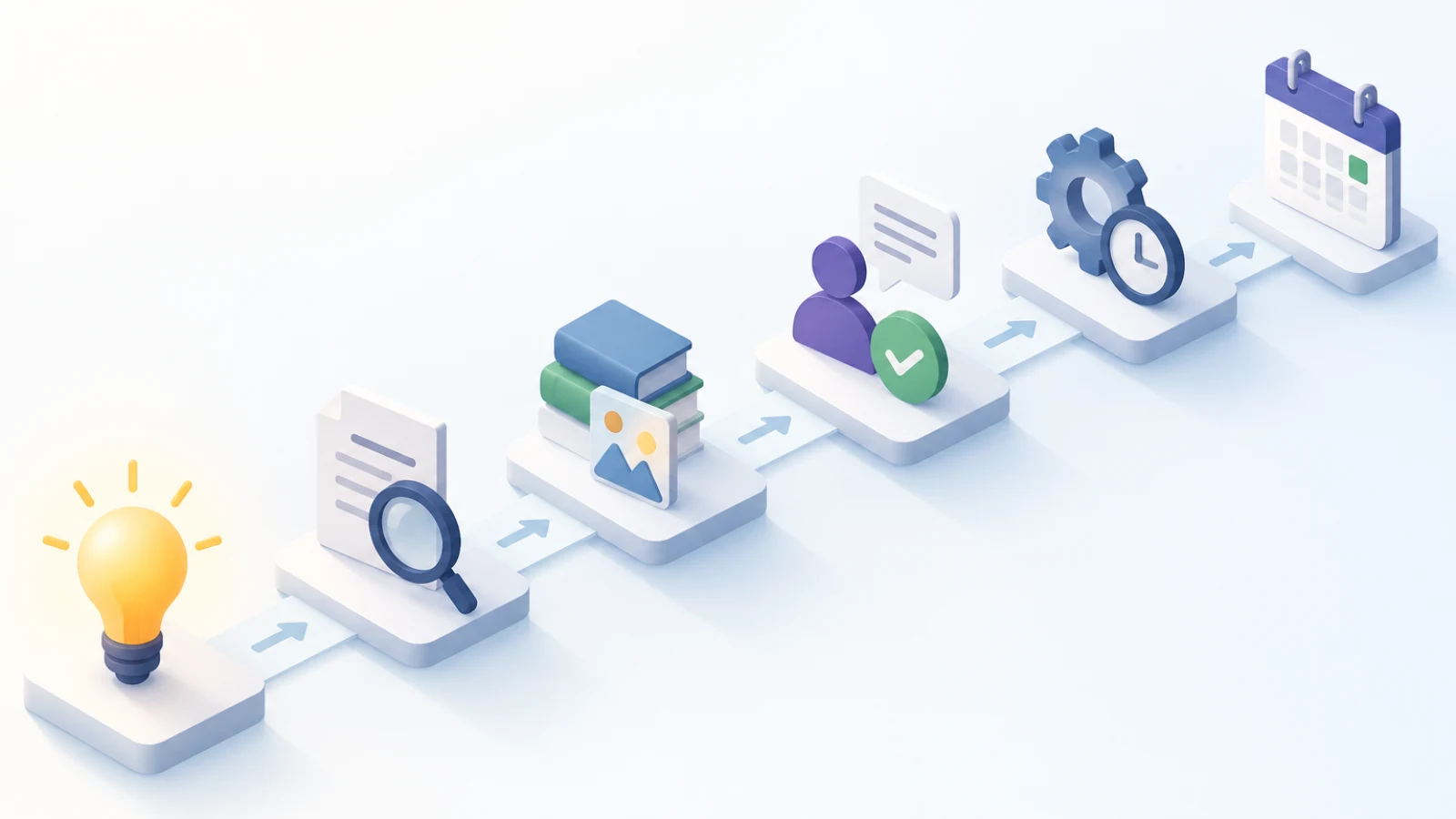
Content idea feasibility is the practical check that asks whether your team can support a proposed article before it goes on the calendar. It helps you identify the reader task, evidence, knowledgeable reviewer, and upkeep the article needs—so a promising idea does not become an unsupported draft or a neglected page.
A topic can sound relevant, fit your audience, and still be unready to publish. Before assigning a due date, test whether you can give readers a clear and useful answer that your organization can stand behind. Content idea feasibility is not a prediction of rankings or traffic. It is an operational decision: can this team responsibly create, review, publish, and maintain this particular article with the information and people currently available?
In this guide
Define the article’s reader task before testing feasibility
Content idea feasibility means assessing whether an article is workable before it is scheduled. A workable topic has a specific reader task, enough reliable material to answer that task, a person who can validate important organization-specific points, and a realistic plan for keeping time-sensitive information current. The test applies to one proposed article, not to your entire marketing strategy.
Write the task as a reader question
Start with the decision or action the reader is trying to complete. “Explain our industry” is too broad to assess. “Help a new customer compare the documents needed before onboarding” is testable: you can identify the audience, scope, supporting materials, reviewer, and points that may change. If the reader task remains vague after a short discussion, narrow the idea before trying to research it.
Why a good-sounding topic may not be ready
A calendar often makes an idea look more settled than it is. A writer may be able to produce fluent copy while the team still lacks approved facts, a current process description, a decision-maker for disputed points, or time to revisit changing details. Scheduling at that stage can shift unresolved work into drafting and review, where it is harder to see and easier to rush.
Google’s people-first content guidance asks creators to consider whether content demonstrates first-hand expertise and depth of knowledge, and whether readers will have learned enough to achieve their goal. Use those questions as a quality prompt, not as a publishing guarantee: an idea needs support that matches the answer you plan to give.
Use five feasibility checks before scheduling
Run the same checks for every candidate topic. The goal is not a perfect score or a lengthy approval process. It is to reveal what must be true for the article to be honest, useful, and manageable. Record short answers in the idea record so that a writer and reviewer do not have to reconstruct the reasoning later.
The five checks
- Reader need: Can you state the intended reader, their situation, and the question or task the article will help with?
- Subject-matter expertise: Can a knowledgeable person explain the practical details, boundaries, exceptions, and terminology that make the answer credible?
- Article evidence: Do you have approved internal information, reliable external sources, direct experience, or clearly attributable materials for the meaningful claims?
- Content review capacity: Is a named person able and authorized to review substantive claims by the required date, with a backup if necessary?
- Maintenance capacity: Can you identify what could change, who will notice it, and when the article should be reviewed or retired?
Treat reviewer availability as an input, not a final-stage surprise
Review is more than proofreading. For a topic that describes your own service, process, product, policy, or technical practice, identify who can confirm the substance and who has authority to resolve disagreements. The Department for Education’s content workflow guidance recommends clarifying roles and responsibilities, feedback and sign-off tracking, and a backup plan when a contributor is unavailable. Adapt that principle to the scale of your team.
Build a simple readiness scorecard
Score each check from 0 to 2 for a quick, comparable view. A score is a conversation aid, not proof that an article is correct or ready. A zero on an essential requirement—such as no safe source for a central claim or no qualified reviewer—should override a high total and trigger a different next action.
Topic readiness scorecard
| Check | 0 — not ready | 1 — partly ready | 2 — ready enough to schedule |
|---|---|---|---|
| Reader need | No defined reader task | Reader or task is broad | Reader, situation, and intended answer are specific |
| Expertise | No knowledgeable input identified | Expert is identified but key details are unknown | Knowledge owner can explain scope and exceptions |
| Evidence | Central claims lack support | Some evidence exists but gaps remain | Central claims have usable sources or direct confirmation |
| Review capacity | No reviewer or authority | Reviewer is possible but timing is uncertain | Named reviewer and decision route are available |
| Maintenance | Change risks are unknown | Risks are known but no owner is assigned | Review trigger, owner, and response are recorded |
As a working rule, schedule ideas with no essential zeros and a score that reflects enough support for the proposed scope. Narrow or research an idea with one or two solvable gaps. Defer it when the missing information depends on a future decision, unavailable expert, or unbuilt process. Decline it when the organization cannot support the central answer without speculation.
Separate missing inputs from true blockers
Not every unknown blocks an article. Mark each gap by its relationship to the promised reader outcome. A missing illustrative image may delay a preferred format but does not necessarily stop a well-supported explanation. By contrast, an unconfirmed eligibility rule blocks an article whose main purpose is to tell readers whether they qualify. This distinction prevents teams from treating every imperfection as equal while still protecting the core answer.
Record each gap with four fields
- Missing input: State exactly what is absent, such as a current policy owner or approved process steps.
- Why it matters: Connect the gap to a claim, reader decision, or maintenance risk.
- Owner and due point: Name the person or team that can resolve it and the point when it is needed.
- Fallback: Decide whether to narrow the scope, replace the claim, postpone the idea, or decline it.
Illustrative example: assess a proposed article before assigning it
Illustrative example only: a B2B software team proposes “How to choose the right implementation plan.” The idea seems useful, but the initial wording assumes the company can recommend plans and describe its current onboarding process. The team uses the feasibility check before scheduling rather than letting those assumptions enter a draft unnoticed.
Input, mapping, error, and correction
- Input: A proposed 1,200-word guide for prospective customers selecting an implementation approach.
- Mapping: The reader task is to understand preparation questions, not receive a universal recommendation. A customer-success lead can explain the team’s actual preparation process; published help materials support basic terminology; the operations lead can approve current timing and handoffs.
- Error: The outline includes “the best implementation plan” and a fixed timeline, but neither claim is approved for every customer situation. The content review capacity score is also only 1 because the operations lead is away during the planned review week.
- Correction: Rename the article “Questions to ask when preparing for implementation,” remove the universal recommendation and fixed timeline, quote only confirmed process steps, and move the date until the named reviewer or an authorized backup can review it.
Choose the next action instead of forcing every idea into the calendar
A feasibility review should end with a clear disposition. “Maybe later” loses the useful diagnosis. Give the idea a next action and preserve the reason, especially when a topic may become workable after a product change, completed research, or new reviewer availability. That record makes future planning faster and avoids reopening the same unresolved debate.
Four useful outcomes
- Research: The reader task is sound, but specific evidence or direct confirmation is still needed.
- Narrow: The broad topic is not supportable, but a smaller question can be answered accurately now.
- Defer: The topic depends on a pending decision, unavailable expert, or future operational capability.
- Decline: The organization lacks a responsible basis to answer the central question, and no realistic path to support it is available.
Keep feasibility separate from content prioritization
Feasibility asks, “Can we support this topic?” Prioritization asks, “Which approved topic should we do first?” They should happen in that order. Comparing an unsupported idea against ready-to-produce articles creates misleading choices because urgency, commercial relevance, and audience interest cannot solve an evidence or ownership gap. Once an idea passes its readiness check, you can use a separate process to prioritize approved content ideas.
A readiness decision is one input to a broader editorial system. After you know which topics are supportable, connect them to audience goals, publishing capacity, and a realistic cadence as you build a content plan for your business website. Keep the feasibility notes with the idea so that the plan reflects what your team can actually substantiate and maintain.
Key takeaways
- Test a topic before scheduling it by checking reader need, expertise, evidence, review capacity, and maintenance capacity.
- Treat missing support for a central claim or the absence of a qualified reviewer as a blocker, not a drafting problem.
- Use a small scorecard to make gaps visible, then record a specific next action for each idea.
- Narrowing or deferring a topic can preserve usefulness and accuracy better than forcing a broad article into the calendar.
- Assess feasibility before you compare ready topics for priority.
Frequently asked questions
Make your content plan workable
If your team has useful business knowledge but needs a practical way to turn confirmed inputs into supportable topics, explore SearchWeave’s Content research and planning.