
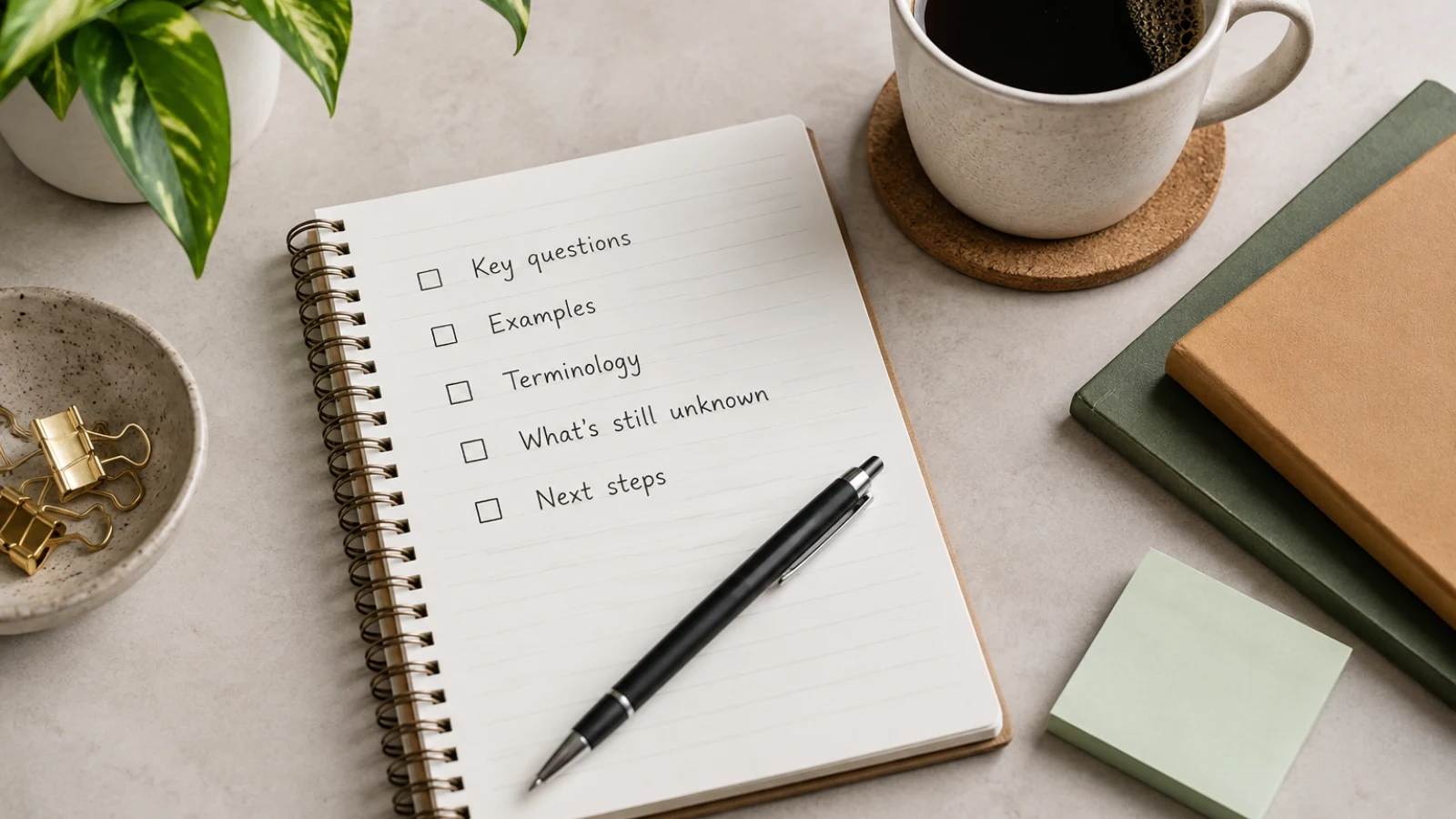
Subject-matter expert interviews for content give a writer the operational detail, examples, terminology, and limits needed to plan a useful article—without turning a busy expert into the article’s author. Use a short, prepared conversation to capture what is known, label what still needs verification, and create a reviewable handoff for drafting.
A strong article often starts before anyone writes a draft. It starts when a content planner can ask a knowledgeable person focused questions about a reader’s problem, the real process behind the answer, and the boundaries that keep the explanation honest. Subject-matter expert interviews for content are a practical way to collect those inputs. The aim is not to extract a polished essay from an expert. It is to give a writer and reviewer reliable material they can shape into an article that helps a defined reader complete one task.
In this guide
Assign clear roles before the interview
Define who supplies knowledge, who makes editorial decisions, and who approves factual accuracy. This separation protects the expert’s time and avoids a common stall: a draft circulates because nobody knows whether an expert is being asked to check facts, rewrite the prose, approve publication, or all three. A useful default is simple: the interviewer gathers and organizes input; the expert explains the subject and flags inaccuracies; the writer drafts for the reader; and a named reviewer confirms the final factual and business-specific details. Defra describes a comparable content workflow in which subject-matter experts check factual accuracy while dedicated content designers draft the text.
A practical responsibility map
| Role | Primary responsibility | What to ask them to approve |
|---|---|---|
| Content planner or interviewer | Sets the article objective, agenda, and follow-up record | That the notes reflect the conversation and open questions are visible |
| Subject-matter expert | Explains the process, examples, terminology, exceptions, and constraints | Factual statements, operational details, and material limitations |
| Writer | Turns approved inputs into a reader-focused article | Clarity, structure, and whether the article answers its stated question |
| Editor or accountable reviewer | Resolves conflicts and decides whether the draft is ready to publish | Final factual fit, business language, and publication readiness |
Prepare a narrow interview objective
Preparation determines whether the conversation produces usable detail or a broad tour of everything the expert knows. Before inviting anyone, write one reader question the future article must answer. Then state what the reader should be able to understand, prepare, or do after reading. Keep adjacent stages separate: topic research identifies candidate questions, an interview captures expertise for one chosen question, a content brief defines the assignment, and review tests the eventual draft. This boundary prevents the meeting from becoming an unprioritized brainstorming session.
What to send before the call
- The proposed reader and the precise question the article will answer
- A one-sentence scope statement, including what the article will not cover
- A short agenda with the main areas you want to understand
- Any approved source material, product documentation, or prior content to inspect
- A request for examples that may be shared publicly and examples that must stay private
- The expected follow-up: notes, factual review, and a deadline for corrections
If the question has not yet been selected, start by organizing the organization’s knowledge into distinct audience needs and viable article opportunities. If it has been selected, place the interview in the wider sequence of a content plan for a business so the resulting article has a clear purpose rather than merely adding another topic to a list.
Run a short conversation that follows the reader’s task
Open by explaining the article’s audience, question, and intended use of the notes. Tell the expert that they are not responsible for writing the final article. Ask permission before recording, and record the consent decision in the interview record. Start with the normal path a reader should understand, then use follow-up questions to reveal conditions, exceptions, decision points, and terms a newcomer may not know. An interviewer who asks “what happens next?” and “what would change that answer?” will usually collect more useful material than one who asks for general thoughts on a topic.
A simple interview sequence
- Restate the reader question and the article boundary
- Ask the expert to describe the usual process in the order it happens
- Identify decisions the reader must make and the information each decision requires
- Request a concrete, shareable example that shows the process in context
- Ask what can go wrong, what does not apply, and when another person or source is needed
- Confirm exact terminology, names, and details that must be verified before publication
- Recap the key points, unresolved questions, and the factual review process
Ask questions that surface usable article inputs
Question prompts and the material they produce
| Ask | Why it helps the article | Capture in your notes |
|---|---|---|
| What is the reader trying to accomplish before they come to us? | Keeps the article focused on a real task | Reader situation and desired outcome |
| What is the usual process from first step to completion? | Creates a logical sequence for the explanation | Steps, inputs, decisions, and outputs |
| What would a first-time reader misunderstand? | Reveals gaps a generic draft might miss | Terms to define and assumptions to challenge |
| What changes the answer or creates an exception? | Prevents an overly absolute explanation | Conditions, limits, and escalation points |
| Can you walk through one representative example? | Makes abstract guidance easier to apply | Scenario, actions, result, and allowed level of detail |
| Which statements must be checked against a current source? | Separates knowledge from publishable claims | Source owner, date, and verification task |
Avoid treating every answer as ready-to-publish truth. An interview is a valuable source of operational context, but a comment may be incomplete, dated, confidential, or in conflict with another approved record. Mark each important note as approved, needs verification, restricted, conflicting, or illustrative. That status makes uncertainty visible to the writer instead of hiding it inside fluent prose. It also gives the team a defined follow-up task rather than an invitation to guess.
Turn the notes into a fact pack and brief
Do the synthesis soon after the conversation while the context remains clear. Do not hand a transcript directly to a writer and expect the draft to distinguish settled facts from loose remarks. Instead, convert the notes into a compact fact pack: a controlled handoff that lists the proposed claim or explanation, the expert’s wording in your notes, its status, any supporting source, the owner of the next check, and its permitted use. Keep quotes separate from paraphrases, and keep fictional teaching scenarios visibly labeled.
Minimum fact-pack fields
- Article question and intended reader
- Interview date, participant, and interviewer
- Process notes organized in the reader’s likely order
- Approved terminology and plain-language definitions
- Examples that are authorized for public use
- Limits, exceptions, risks, and items outside the article’s scope
- Claims needing verification, their source owner, and the next action
- Conflicts or unknowns that must remain out of the draft until resolved
- Factual review owner and due date
Once the fact pack is complete, use it to prepare a content brief from approved expert input. The brief should decide the article’s reader, purpose, scope, outline, evidence needs, and review owner; it should not silently convert unverified interview notes into claims. A brief gives the writer a clear assignment while preserving the link between important statements and the people or records that can check them.
Illustrative: map one answer before it becomes a claim
Illustrative worked example
Input: An operations expert says, “We can usually start a new client quickly once we have everything.” Mapping: Record the useful process insight as “The start date depends on receiving the required inputs,” assign the expert as the owner, and mark timing as needs verification. Error: The draft says, “New clients can start immediately.” Correction: Remove the unsupported timing promise. Use a qualified explanation only after an approved source or owner confirms the applicable conditions; otherwise say that the team should confirm required inputs and timing directly.
Use factual review to resolve uncertainty, not rewrite style
Send the reviewer a focused factual-check request rather than an open-ended request to “take a look.” Include the article question, the draft or relevant excerpts, the specific claims that need confirmation, and a date for response. Ask reviewers to identify what is incorrect, incomplete, outdated, or outside approved scope and to point to the needed correction or source. Natural Resources Wales similarly distinguishes factual accuracy review from rewriting content style or tone.
After factual questions are resolved, review the whole article for accuracy, scope, clarity, and fit for the intended reader. The review should test whether the draft preserves the approved conditions and boundaries from the interview, not merely whether it sounds confident. For a fuller editorial pass, see How to Review AI-Generated Content for Accuracy and Fit.
Reuse interview material carefully across articles
One interview can support more than one article when the material contains distinct reader questions, but do not treat that as permission to spread a broad conversation across loosely related pages. Create a separate brief for each article, select only the inputs relevant to its question, and recheck details that may have changed. Record which articles used a fact pack so a later correction can be applied consistently. As topics become ready, place only the approved assignments into a calendar the team can actually maintain.
A sustainable schedule should reflect available expertise, drafting capacity, and review time. How to Create a Content Calendar a Small Team Can Maintain can help turn approved article work into a manageable publishing rhythm without treating an interview as a promise that a draft is ready to release.
Key takeaways
- Interview for a defined reader question, not for everything an expert knows
- Tell experts they are supplying knowledge and factual review, not writing the article
- Capture processes, examples, conditions, terminology, and limits in the reader’s likely order
- Label each important note by its approval and verification status
- Turn notes into a fact pack before creating the content brief or draft
- Give a named reviewer a focused factual-check request with a clear response date
Frequently asked questions
Organize expertise into a workable content process
SearchWeave can help organize approved business expertise into planned article briefs and drafts for review through Content research and planning.